Column Subset Selection: how to choose a small representative subset from millions of data points?
Why a small subset of actual matrix columns can provide an interpretable, structure-preserving low-rank approximation, and how common CSSP algorithms choose them.
In the modern world, we casually interact with millions of data points on a daily basis. They may come from high-res images, recommendation systems, or sensors on a weather station. Regardless of their origins, numerical analysts can view them in the same way: as columns in a matrix.
Luckily for us, these numbers do not necessarily require millions of degrees of freedom to store them. The nearby pixels in an image are likely to be correlated; someone who favours Mary Poppins might also enjoy Alice in Wonderland, and weather measurements in London may follow some seasonal trend each year. Large datasets can often come with a large degree of redundancy.
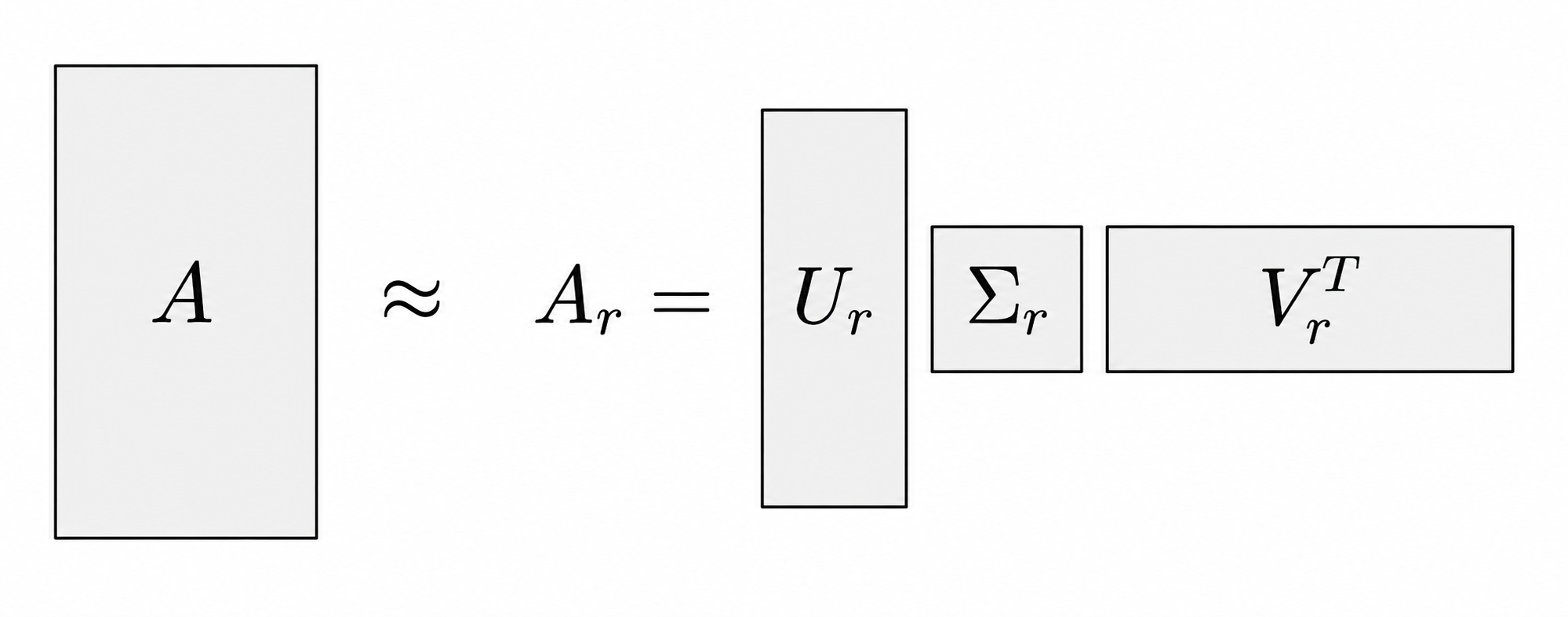
We can describe this idea more precisely using the term “low-rank structure”. If you are reading this blog, I’m guessing you’ve come across the singular value decomposition (SVD) or principal component analysis (PCA) before. In short, the SVD uncovers the dominant directions of your data that contribute most to the “information” stored in your matrix. If only a few of these directions are important, we can safely truncate all the other directions and replace the original matrix with a lower-rank one, which is much easier to store and operate on.
Some problems with the SVD
The truncated SVD gives the optimal low-rank approximation to an matrix ; that is, amongst all rank- matrices , the approximation obtained from truncating the SVD has the smallest error measured in, say, the Frobenius norm (or any unitarily invariant norm).
However, there are a few things that make the SVD less suitable in some applications. The SVD finds the dominant directions, which are complicated linear combinations of columns. Wouldn’t it be nicer if we could actually know which columns are important? As a concrete example, a column might represent a viewer’s interests across different movies. A selection of columns can pick out some particular viewers whose interests represent the entire audience base. The SVD, however, would produce an abstract combination of different viewers.
Another problem is updating the matrix. For example, if the weather station collects a new day of data, this might be represented as a new column in the matrix. If we use the SVD, this requires us to update the SVD of the new matrix, which can be expensive. If we select specific columns instead, we can simply decide whether the new column is important or not.1
The final issue I would like to mention is preserving the structure. If a matrix is, for example, sparse, i.e., it contains a lot of zeros, its SVD is, in general, still going to be dense. However, since a column subset uses the exact entries of the original matrix, it can better preserve the sparsity structure.
The column subset selection problem
How to pick columns that best represent the whole matrix is known as the column subset selection problem (CSSP), and it is a very active area of research in numerical linear algebra.
Given an matrix , we select an column submatrix . Here, is the index set containing the indices of the columns selected, and is MATLAB notation for the columns indexed by . In order to approximate using , we form , where denotes the Moore–Penrose pseudoinverse. This is called the one-sided interpolative decomposition (ID).
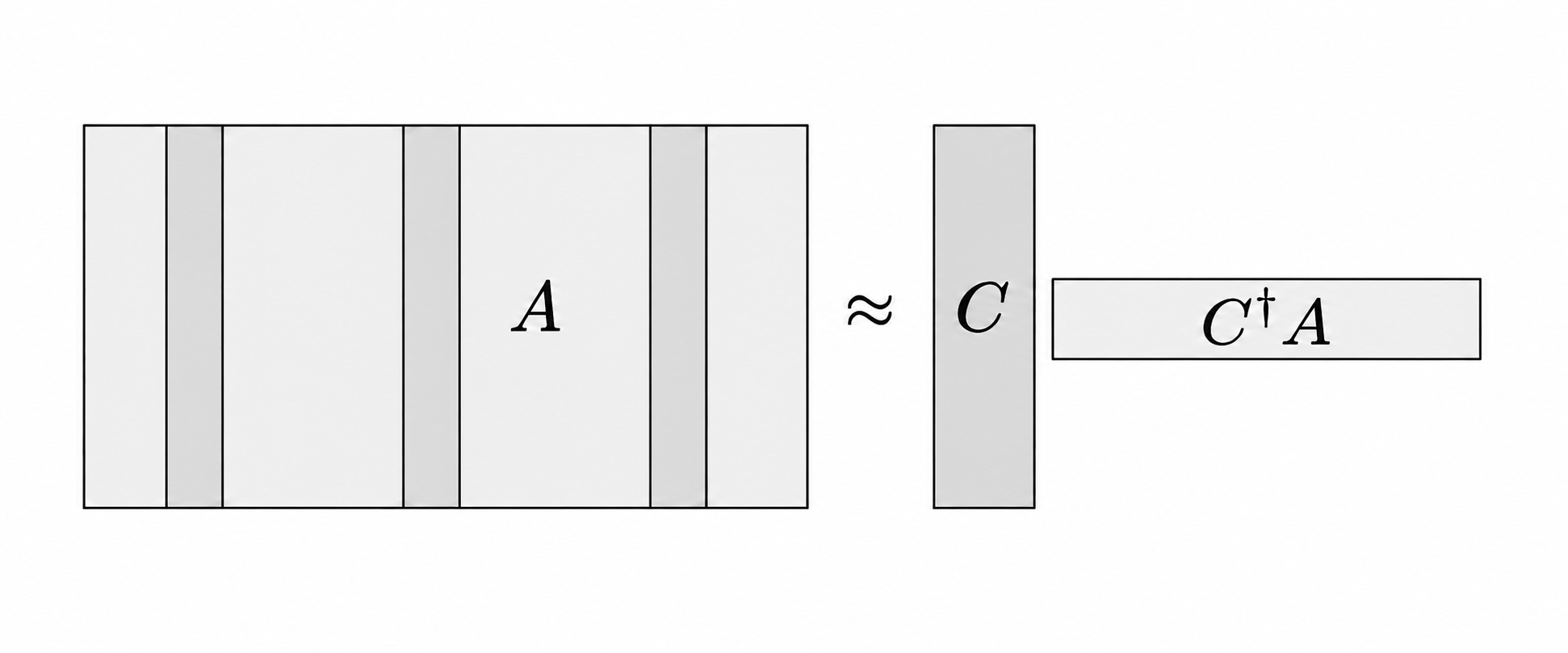
The big idea is that is a projection onto the space spanned by the columns of . is like a shadow cast from onto the column space of , and we hope that, by choosing a proper , this shadow looks as much like as possible. We also note that the one-sided ID is a low-rank approximation, since is .
To measure how good is, we can calculate the error . What’s great about column subset selection is that it is provable that for any matrix and target rank , there exists a column subset such that
Recall that is the best possible rank- approximation from truncating the SVD of , and is typically quite small. That is, by just using the exact columns of , we can achieve an approximation accuracy that is within a constant factor (depending on ) of the best approximation. Isn’t that something!
How to choose C?
I will now try to answer the question in the title: how to choose these columns? There are many methods to do so, and I list some popular ones (that I have some brief experience with) here. Details and implementations for the methods below can be found online. I will only give a brief description and some informal thoughts on them.2
-
Column-Pivoted QR (CPQR): CPQR selects the column of the current residual with the largest norm, then projects out that column from the matrix through a step in QR factorisation (known as a Householder reflection), and repeats this process times. CPQR can be unreliable when facing adversarial examples since it’s deterministic.
-
LU with partial pivoting (LUPP): pivots are the diagonal entries of a matrix. LUPP selects the column with the largest pivot, then uses Gaussian elimination to remove the column. It has the same issue with adversarial inputs since it’s also deterministic.
-
Osinsky’s Method [1]: This is a relatively recent method and the first deterministic method that satisfies the optimal guarantee using only one SVD. It is, however, more expensive to use in practice than the previous methods.
-
Adaptive randomised pivoting (ARP) [4]: ARP is a randomised algorithm inspired by Osinsky’s method and satisfies the same optimal guarantee in expectation. It is much simpler and cheaper to use than Osinsky’s method (more practical with the same guarantee!), but requires a (randomised) orthogonalisation step from an SVD/QR factorisation.
-
Randomly Pivoted QR [2]: this is a randomised method that I have become interested in. It is closely related to CPQR. Instead of always choosing the column with the largest norm, it selects randomly with probability proportional to the columns’ norm squared. This makes it less vulnerable to adversarial inputs as it’s no longer deterministic. It is also cheaper than the ARP, though it does not have the optimal theoretical guarantee.3
-
RandLUPP [3]: this is a randomised version of LUPP. It does not yet have a theoretical guarantee either, but it’s a fast and accurate method I personally favour in practice (LU only needs half the time of QR!)
Before you go: the idea that a few exact columns can accurately represent the entire matrix is quite mind-blowing to me, and it’s something that can find more applications to other scientific problems. Whether you want to find some representative data or need a low-rank approximation,4 I hope you might consider selecting some columns!
References
- Osinsky, A. I. “Close to optimal column approximation using a single SVD.” Linear Algebra and its Applications (2025).
- Chen, Yifan, Ethan N. Epperly, Joel A. Tropp, and Robert J. Webber. “Randomly pivoted Cholesky: Practical approximation of a kernel matrix with few entry evaluations.” Communications on Pure and Applied Mathematics 78, no. 5 (2025): 995-1041.
- Dong, Yijun, and Per-Gunnar Martinsson. “Simpler is better: a comparative study of randomized pivoting algorithms for CUR and interpolative decompositions.” Advances in Computational Mathematics 49, no. 4 (2023): 66.
- Cortinovis, Alice, and Daniel Kressner. “Adaptive randomized pivoting for column subset selection, DEIM, and low-rank approximation.” SIAM Journal on Matrix Analysis and Applications 47, no. 1 (2026): 25-47.
Footnotes
-
This is something of an oversimplification, since, to determine whether the new column is important, we need to compare it with the previous columns. However, this is still much easier than updating the SVD. ↩
-
In a future blog, I will provide some numerical experiments and compare their performance. ↩
-
This can be remedied with oversampling. ↩
-
The one-sided ID is not the favoured approximation method in practice. Should I write a blog on CUR? ↩
Comments
Comments are hosted by FastComments. No account or email address is required.